Washington Update
Rally for Medical Research Brings Advocates Together
By: Ellen KuoThursday, September 24, 2026
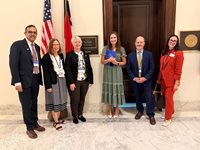
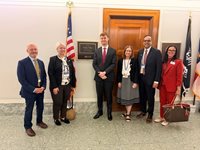
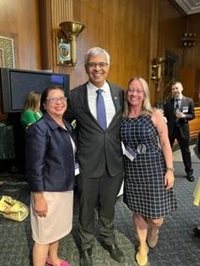
FASEB participated in the Rally for Medical Research by sending several people, including Amy Whitaker, PhD, representing the Environmental Mutagenesis and Genomics Society, and Heidi Lempradl, PhD, representing the Genetics Society. Both are FASEB member societies. According to Whitaker, “There has never been a more important moment to advocate for science funding in the United States. Stable investment in research drives lifesaving discoveries and a healthier future for generations to come. I am grateful to FASEB and its partners for ensuring that scientists, patients and advocates are heard.”
Whitaker also said, “As a cancer researcher studying pancreatic cancer, I see both the enormous challenges that remain and the exciting progress we are beginning to make. Recent advances show what sustained investment in biomedical research can accomplish and why this is exactly the time to build on that momentum. My own career was launched by an NIH Pathway to Independence Award, and I now lead an NIH-funded research lab at Fox Chase Cancer Center. Traveling to Capitol Hill with FASEB gave me the opportunity to represent the Environmental Mutagenesis and Genomics Society, Fox Chase Cancer Center, and the broader research community in Pennsylvania, while also speaking as a constituent. It was incredibly meaningful to share directly with our congressional offices that continued support for NIH allows us not only to pursue the discoveries that can change outcomes for patients, but also to train the next generation of scientists who will make those discoveries. We are seeing the returns on decades of investment in biomedical research right now, and continued support is essential to keep that progress moving forward.”
Darla Henderson, Executive Director and CEO of FASEB, also attended a meeting with the congressional delegations with FASEB president and talked about the value of medical research supporting patients, with the added benefits of economic activity and keeping America first in the world in biological research. They sought $51.3 billion for NIH and also the elimination of the OMB-proposed rule on federal financial assistance, as it would be harmful to the scientific enterprise and researchers counting on stable funding to complete their work.
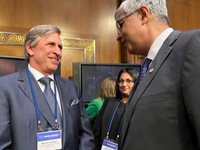
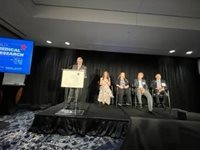
FASEB President Michael Lehman moderated a breakfast panel of patient advocates and medical professionals during the morning hours of the Rally for Medical Research. Lehman is also the Regents Endowed Professor and Chair at New Mexico Institute of Mining and Technology. A distinguished neuroscientist, his research on the neural control of reproduction and circadian rhythms has led to fundamental discoveries in neuroendocrinology.
The panelists were the following:
- Michelle Alonso is a Virginia-based advocate and a passionate volunteer with the Alzheimer’s Association, and she was recognized as Alzheimer’s Impact Movement’s (AIM) October Advocate of the Month.
- Mary Morlino is a phenomenal member of the rare disease community, as she is the founder of Maryland Rare and a former member of the EveryLife Foundation team, which has strong ties to most national rare organizations.
- Henry Rodriguez, MD, received the Federal Advocate of the Year Award in 2026 from the American Diabetes Association® (ADA). Dr. Rodriguez also serves as clinical director of the University of South Florida’s Diabetes and Endocrinology Center and is the principal investigator for the National Institutes of Health-funded USF TrialNet Clinical Center and the Epidemiology of Diabetes Interventions and Complications trial center.
- Robert A. Wolff, MD, is a Professor of Medicine in the Department of GI Medical Oncology at MD Anderson Cancer Center. Dr. Wolff serves as former Senator Ben Sasse’s (R-NE) primary physician/oncologist. He has spent nearly three decades seeing firsthand how sustained investments in medical research have resulted in some extraordinary progress, most recently for patients with pancreatic cancer.